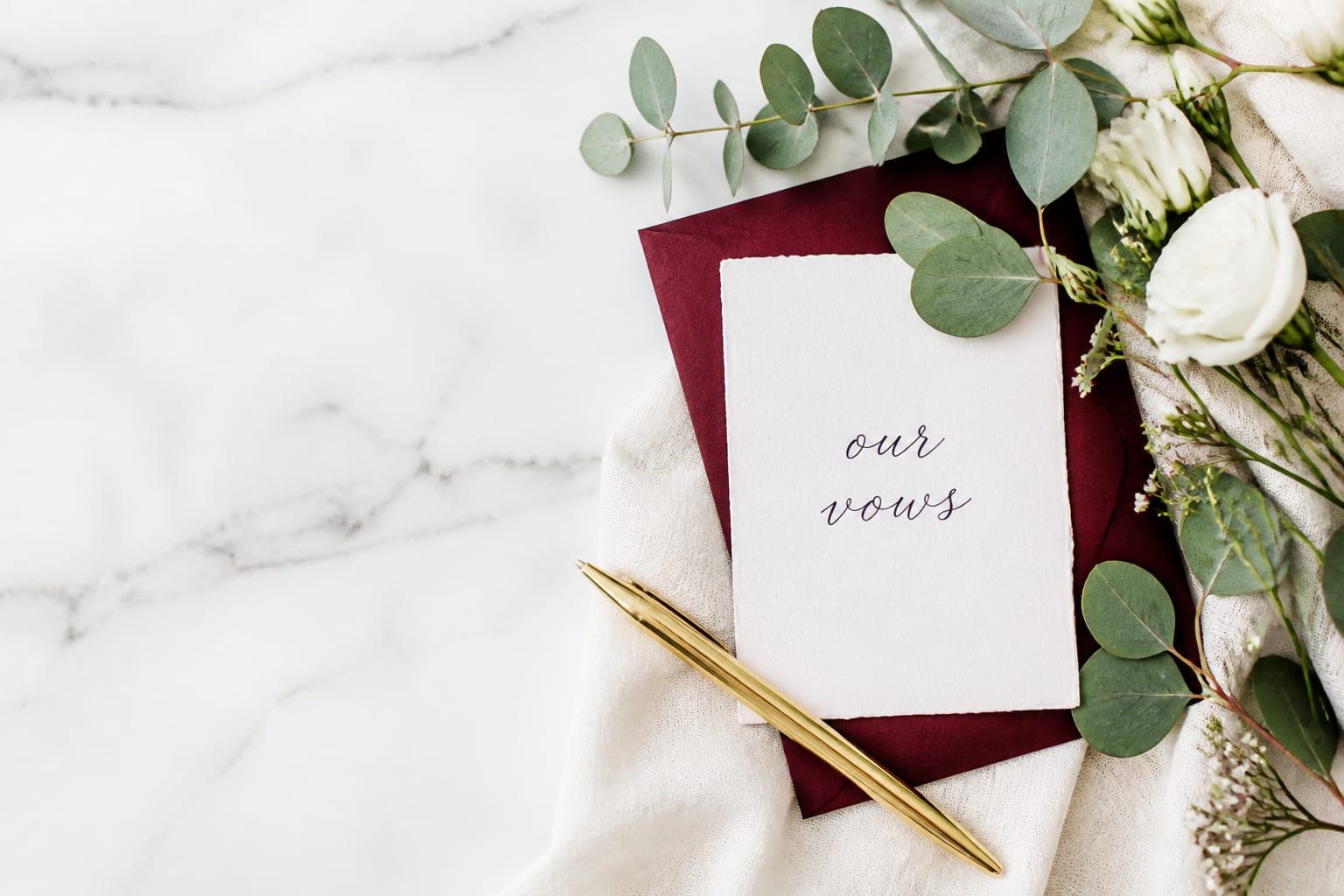
Simple wedding vows for a clear, heartfelt ceremony
Simple wedding vows that stay short and still sound like you, with five full examples, a three-sentence structure, and the words to cut first.
1,814 words of guidance 5 full wordings Copy and personalize
Editorial status: general writing guidance based on the visible methodology; no page-level professional, cultural, or religious review is claimed. Last revised July 21, 2026. Read the policy.
Move from reading to writing
Use only the details you choose, then edit, version, rehearse, and print privately.
Simple vows are not a compromise. They are a decision about attention: fewer sentences, each doing real work, so the room hears the promise instead of the writing.
The examples below run from about forty words to just over a hundred. Every one of them can be spoken by a nervous person holding a shaking card, which is the actual design requirement most vow advice ignores.
If you have been staring at a blank page for a month, start here. Simple vows are the shortest route from nothing to something you would be proud to say out loud.
The short answer
Simple wedding vows run about 60 to 120 words, or roughly 30 to 60 seconds spoken.
The reliable spine is three sentences: what you love, what you promise, what you choose. Everything else is optional.
Cut adjectives before you cut promises. Two clear promises beat five decorated ones.
Simple does not mean generic. One concrete detail is what separates a short vow from a greeting card.
Write the last line first. Once you know how it ends, the rest gets short quickly.
What simple actually means here
Simple does not mean traditional, and it does not mean vague. A simple vow uses plain words, short sentences, and one idea at a time. It can still be deeply personal, and it can still make people cry.
The difference is where the effort goes. In a long vow, the effort goes into building. In a simple vow, the effort goes into cutting. You are writing 300 words and keeping the best 80.
That is why simple vows often feel more emotional in the room. Nothing stands between the guests and the promise, so the meaning arrives on the first pass instead of the third.
The three-sentence spine
Almost every simple vow that works follows the same three beats. Write one sentence for each, in this order, and you have a complete vow before you have written anything difficult.
First, what you love, stated concretely. Second, what you promise, limited to two things you can actually do. Third, what you choose, which is the line you say while looking up.
What I love: I love the way you make every room easier to be in.
What I promise: I promise to be honest quickly and kind on the hard days.
What I choose: I choose you today, and I will keep choosing you.
If you want a fourth beat, add one specific memory between the first and second sentences. That single detail is usually what makes a short vow sound like yours.
A word budget that works
Length anxiety causes most vow paralysis. Set a number before you write and the drafting gets easier, because you are solving a defined problem instead of an open one.
These ranges assume a calm ceremony pace of about 130 words a minute, which is slower than normal conversation and roughly what nerves plus a microphone produce.
40 to 60 words: about 20 to 30 seconds. One promise, said perfectly. Good for a courthouse or a very short ceremony.
60 to 90 words: about 30 to 45 seconds. The sweet spot for simple vows with one detail in them.
90 to 120 words: about 45 to 60 seconds. Room for a memory, two promises, and a closing line.
Over 150 words: no longer simple. That is fine, but write it as a full vow rather than a trimmed one.
The words to cut first
Simple vows get written by deletion. Take your draft and remove these in order, reading aloud after each pass. Most drafts lose a third of their length and improve.
Do the passes on separate days if you can. Cutting your own writing an hour after you produced it is difficult; cutting it on Tuesday when you wrote it on Sunday is easy and slightly enjoyable.
Intensifiers: very, really, so, truly, absolutely, incredibly. They add length and subtract force.
Throat clearing: I just want to say, I never thought I would be standing here, words cannot express.
The second metaphor. Keep the better one and delete the other without mourning it.
Any sentence explaining the sentence before it. If the first was clear, the second is padding.
Promises you cannot keep. I promise to always make you happy is not a promise, it is a wish.
One detail keeps it from sounding generic
The risk of simple vows is not plainness, it is interchangeability. You are my best friend and my greatest love could be said by any of the couples marrying today.
The fix costs one sentence. Name a habit, an object, a place, or a thing they say. You always take the aisle seat so I can sleep. You text me the crossword answer at eleven every night.
Put the detail early, before the promises. It buys the rest of the vow credibility, and it gives you something concrete to say while your voice steadies.
Simple vows for nervous speakers
If public speaking frightens you, short vows are not just easier, they are better. A steady sixty seconds beats three shaky minutes, and guests remember composure more than content.
Print your vows in 16 point type on a single card, one sentence per line, with a blank line between sentences. Line breaks are permission to breathe. A folded piece of paper trembles visibly; card stock does not.
Memorize the first sentence and the last sentence only. Read the middle. That gives you eye contact at both moments that matter and removes the fear of blanking.
Ask your officiant to hold your card until the moment you need it. Holding paper for twenty minutes is what makes hands shake by the time you speak.
Matching your partner without matching word for word
Agree on a range, not a script. One partner writing 60 words while the other writes 400 looks like a difference in feeling, even when it is only a difference in style.
The cleanest agreement is a time limit rather than a word count: under a minute each, or one to two minutes each. Say it out loud a month before the wedding and again a week before, when one of you has quietly written a fourth page.
Some couples go further and use the same opening and closing lines, with different middles. The symmetry sounds deliberate and it keeps both vows honest about length.
Where simple vows fit best
Some ceremonies actively want short wording, and choosing simple vows for those settings is a practical decision rather than an emotional one.
Outdoors, sound is the enemy. Wind, traffic, and open air eat consonants, and long sentences lose their ends. Short lines survive a bad microphone.
Civil and courthouse ceremonies, where your personal words sit alongside a fixed legal declaration and the whole slot may be a few minutes.
Beach, garden, and rooftop ceremonies, where wind and ambient noise punish long sentences.
Large weddings, where the vows are amplified and every extra minute is felt by two hundred people standing in the sun.
Bilingual ceremonies, where each line is spoken or translated twice and length doubles automatically.
Second marriages with children present, where brevity keeps the focus on the family rather than the performance.
Full wordings you can use
Read the complete text, copy it, or take it into the private writer and make it yours.
The three-sentence vow
The spine with nothing added. Around twenty-five seconds, and complete.
Maya, I love that you make every room easier to be in.
I promise to tell you the truth quickly, and to be kind on the days that are not easy.
I choose you today, and I will keep choosing you.
about 19 seconds spoken41 words
Three sentences, one idea each. If you use nothing else on this page, use this shape and change the middle sentence to a promise that is actually yours.
The plain promise vow
For couples who want warmth without imagery. No metaphors, no build, just promises said plainly.
Chris, I am not going to try to be poetic, because you would know I was performing.
So here is what I mean. I promise to be honest with you, even when honesty is inconvenient for me. I promise to take my share of the boring work. I promise to come back and repair things after an argument instead of waiting for it to fade.
I promise to be glad you are here, out loud, often enough that you never have to wonder.
That is what I have. It is yours for the rest of my life.
about 45 seconds spoken97 words
Naming your own plainness in the first line is a legitimate move. It sets expectations, gets a small laugh, and buys sincerity for everything after it.
The one-detail vow
A short vow with a single concrete image doing all the personalization.
You take the aisle seat every time so I can sleep against the window.
That is a small thing. It is also exactly who you are, and it is why I trust you with the large things.
Sam, I promise to notice what you give up quietly. I promise to give some of it back.
I am choosing you, today and every ordinary day after it.
about 30 seconds spoken66 words
Under eighty words and impossible to mistake for anyone else's vows, because the first line is a fact about one person.
The simple repeat-after-me vow
Broken into short phrases so an officiant can feed them to you a line at a time.
Officiant
Repeat after me. I, Maya, take you, Chris,
You
I, Maya, take you, Chris,
Officiant
to be my husband from this day on.
You
to be my husband from this day on.
Officiant
I promise to be honest with you, to be kind to you,
You
I promise to be honest with you, to be kind to you,
Officiant
and to stay when things are hard.
You
and to stay when things are hard.
Officiant
I choose you today, and every day after today.
You
I choose you today, and every day after today.
about 44 seconds spoken85 words
Repeat-after-me doubles the elapsed time, so write half as much as you think you need. Keep every phrase under nine words or people lose the end of the line.
The simple vow for a second marriage
Short, adult, and unembarrassed about history. Works when children or long relationships are in the room.
I know what a marriage costs, and I am here anyway. That is not a small sentence, and I mean every word of it.
Maya, I promise to be honest with you before it is comfortable. I promise to protect what we are building, including from me on my worst days.
I promise to make room for your children and mine, and to be steady enough that they can count on me.
I am not starting over. I am starting with you.
about 38 seconds spoken82 words
Second-marriage vows do not need to explain the past. One acknowledging line is enough, and then the vow belongs to the present.
Examples to adapt
Filter, copy, and save examples that match your role and tone.
Provenance: these are synthetic teaching examples written for illustration, not customer submissions or a real couple’s transcript. Replace generic lines with facts you can confirm.
6 examples
FAQs
What are simple wedding vows?
Simple wedding vows are short, plainly worded promises, usually 60 to 120 words. They use everyday language and one idea per sentence rather than extended imagery, which makes them easier to speak and easier for guests to follow.
How long are simple wedding vows?
Most run 30 to 60 seconds, or about 60 to 120 words at a calm ceremony pace. Anything under 40 words starts to feel like a toast rather than a vow.
Are simple vows too plain for a wedding?
No. Clarity reads as sincerity in a ceremony, and a vow you can deliver steadily beats a longer one that breaks down halfway. Guests remember how a vow landed, not how many words it had.
Can my partner and I say the same simple vows?
Yes, and many couples do. Identical vows spoken by both partners sound deliberate and equal, especially in secular ceremonies. Add one personalized line each if you want the symmetry without the sameness.
What is the easiest wedding vow structure?
Three sentences: what you love, what you promise, what you choose. Write one sentence for each, keep each under about 25 words, and you have a complete vow that needs almost no editing.
Do simple vows work in a religious ceremony?
Often yes, but many traditions set the vow wording or restrict what may be added. Ask your officiant early which parts are fixed and which are yours, and keep your personal lines for the place they tell you they fit.
Should I memorize simple wedding vows?
Memorize the first and last lines and read the middle from a card. That gives you eye contact at the two moments that matter without risking a blank in the middle.
What if my partner writes long vows and I want short ones?
Agree on a shared range rather than matching word counts, such as under a minute or one to two minutes each. A large mismatch reads as a difference in feeling even when it is only a difference in writing style.