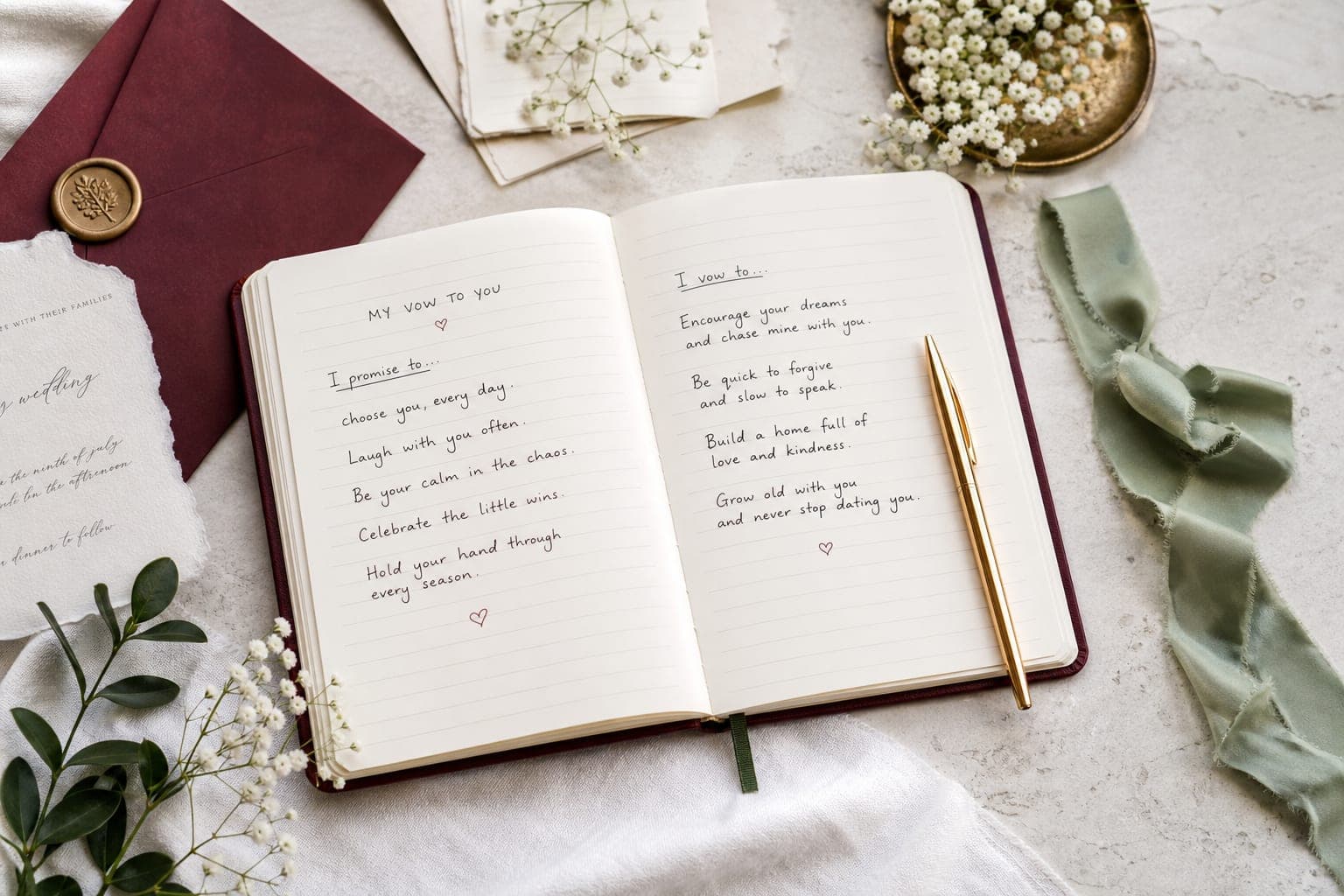
How long wedding vows should be in words and minutes, with speaking-rate math, length by ceremony type, and what to cut when you run long.
2,200 words of guidance 3 full wordings Copy and personalize
Editorial status: general writing guidance based on the visible methodology; no page-level professional, cultural, or religious review is claimed. Last revised July 21, 2026. Read the policy.
Move from reading to writing
Use only the details you choose, then edit, version, rehearse, and print privately.
This is a timing question, so it deserves a timing answer. Most wedding vows should be 150 to 250 words, which is one to two minutes spoken at ceremony pace.
Everything below is the detail behind that number: how words convert to minutes, how the range shifts by ceremony type, how long the whole vow exchange runs once both of you and the officiant are done, and what to cut when your draft is ninety seconds over.
The one rule that overrides all of it: time your actual draft, read aloud, standing, at the pace you will use on the day. Word counts are a planning tool. The stopwatch is the truth.
The short answer
Most wedding vows should be 150 to 250 words, which is about one to two minutes spoken.
At a calm ceremony pace of about 130 words a minute, 130 words is one minute, 260 words is two minutes, and 390 words is three.
Under 100 words still works if every line is specific. Past about 400 words, or three minutes, attention in the room reliably drops.
Both partners plus the officiant's framing and the ring exchange means the vow segment of the ceremony usually runs four to eight minutes.
Repeat-after-me wording doubles the elapsed time, so halve your word count if the officiant will feed you the lines.
Agree with your partner on a range, such as one to two minutes each, rather than on a matching word count.
The short answer in words and minutes
150 to 250 words is the working range for personal wedding vows. That is roughly one to two minutes spoken, and it is long enough for one story, two or three promises, and a closing line.
Traditional vow wording is much shorter. The classic to have and to hold sentence runs about 60 words and takes under thirty seconds, which is why ceremonies that use it feel brisk even when they are formal.
The upper limit is not really a word count, it is attention. Somewhere past three minutes, a vow stops being a promise and becomes a speech, and guests start to notice the sun, their shoes, and each other.
Speaking rate: how words turn into minutes
Conversational English runs around 150 words a minute. Ceremony delivery is slower, because you are pausing, breathing, and occasionally waiting for your own voice to come back. Plan at 130.
Use whichever rate matches how you actually speak, then check it with a stopwatch.
120 words a minute, a slow and deliberate pace: 120 words is one minute, 240 is two, 360 is three.
130 words a minute, the realistic ceremony default: 130 words is one minute, 260 is two, 390 is three.
150 words a minute, normal conversation: 150 words is one minute, 300 is two, 450 is three.
A useful rule of thumb: 45 seconds is roughly 100 words, 90 seconds is roughly 200 words.
Nerves speed most people up. If you time your read and land exactly on target, you are probably a little long on the day, because rehearsal pace and adrenaline pace are not the same thing.
Length by ceremony type
The right length depends less on your writing and more on the room you are standing in. These are the practical ranges for the settings couples ask about most.
Treat them as starting points, then adjust for sound and seating. Guests standing in direct sun have less patience than guests in chairs indoors, and that is a length decision as much as a comfort one.
Courthouse or civil ceremony: 60 to 120 words each. The fixed legal declaration is the anchor and your personal lines sit around it.
Church or liturgical ceremony: often set wording only. If personal vows are allowed, 100 to 150 words is usually what the order of service can absorb.
Outdoor, beach, or garden: 100 to 180 words. Wind and open air eat the ends of long sentences, so shorter lines survive better.
Small or destination ceremony with under thirty guests: 200 to 300 words. Intimacy buys you time nobody resents.
Large formal wedding: 150 to 250 words. Everything is amplified, including the length.
Second marriage or blended family: 120 to 200 words each, plus a short promise to the children if you are making one.
How long the whole vow exchange takes
Couples usually ask about their own vows and then get surprised by the total. The vow segment is not just your words. It is the officiant's introduction to the vows, both sets of vows, and usually the ring exchange stitched to the end.
Budget it like this: 30 to 60 seconds of officiant framing, one to two minutes per partner, and one to two minutes for the ring exchange with its own short wording. That is four to eight minutes in total, which is a substantial share of a twenty to thirty minute ceremony.
If your ceremony also includes a declaration of intent, the will you take questions before the vows themselves, add another thirty seconds. Officiants build this in, but it is worth knowing where the time goes before you decide to write a third page.
How to time your draft honestly
Reading in your head is useless. Silent reading runs far faster than speech and it will convince you that a three-minute vow is ninety seconds.
Do this instead. Stand up. Hold the card the way you will hold it. Read aloud at a pace that feels slightly too slow, with a full pause at every paragraph break. Time it. Then add fifteen percent for the pauses you will take when your voice catches.
Record the read on your phone once. You do not have to listen to all of it. You are checking two things: whether you can hear the ends of your own sentences, and where you rushed.
What to cut when you are ninety seconds over
Long vows are almost never long because of the promises. They are long because of the setup. Cut in this order and stop when you hit your time.
Time the draft again after every two cuts. People routinely delete a paragraph, feel virtuous, and discover they are still ninety seconds over because the paragraph they cut was the short one.
The origin story. How you met is the most cuttable paragraph in any vow, because most guests already know it.
The second joke. One is a warm-up. Two is a routine.
Any sentence that explains the sentence before it.
Adjectives and intensifiers, every one you can lose without changing the meaning.
The list of things you love reduced from six items to three. Three is a pattern; six is an inventory.
Gratitude to parents, friends, and the wedding party. That belongs in a toast and it will land better there.
When longer vows are fine
Some ceremonies can carry three minutes each without strain. A small guest list, seated guests, shade or indoors, good sound, and no other readings all buy you time.
Length is also easier to justify when the vow is doing structural work: naming children by name, acknowledging a parent who died, or carrying a promise the two of you negotiated for real. Guests can tell the difference between necessary length and self-indulgence.
If you go long, break the vow into visible paragraphs and pause between them. A three-minute vow with four landing points feels shorter than a ninety-second wall of text.
Matching lengths with your partner
Vows do not need to be the same length, but a wide gap is the one length problem guests actually notice. Forty seconds followed by three minutes reads as a difference in feeling, which is unfair and completely avoidable.
Agree on a range in advance and check in twice: a month out, and again the week of the wedding when one of you has quietly added a page. If you are not sharing your vows, share the word count.
If one of you genuinely writes short and the other writes long, close the gap from both ends. The short vow gains one detail, the long one loses its origin story, and the two land within thirty seconds of each other.
If your partner is a nervous speaker, the shorter vow is not the smaller gesture. Steady delivery is worth more in the room than an extra paragraph.
Reading, memorizing, and the card in your hand
Length interacts with delivery. Anything past about 150 words is difficult to memorize under pressure, and a memory blank costs more time and composure than reading ever would.
The standard approach: memorize your first and last lines, read the middle. Print in 16 point type, one sentence per line, on card stock rather than folded paper, which shakes visibly.
Hand the card to your officiant before the ceremony and take it back at the moment you speak. Holding paper through twenty minutes of ceremony is what makes hands unsteady by the time it matters.
Full wordings you can use
Read the complete text, copy it, or take it into the private writer and make it yours.
The forty-five second vow
About 100 words. The shortest length that still reads as a vow rather than a toast.
Sam, I love how you are with people. You remember their names, their bad weeks, and what they said last time.
I promise to be honest with you quickly, especially when it is easier to say nothing. I promise to take my half of the tedious work without keeping score.
I promise to keep making you laugh, because I am good at it and you are an easy audience.
I choose you today. I will choose you on the ordinary Tuesdays too.
about 38 seconds spoken82 words
Four short paragraphs, one idea each. Read with a full pause between them and it fills the moment without hurrying.
The one-minute vow
About 130 words at ceremony pace. The most common length couples land on once they have timed a draft.
Maya, the day the car broke down outside Reno, you laughed before I did. I have thought about that a lot. Most people would have been furious, and you were already looking for the funny part.
That is what you do. You find the liveable version of a bad situation, and then you make me live in it with you.
So I promise to be steady when it is my turn. I promise to say what I need instead of hoping you will guess. I promise to protect your time, your work, and your sleep, because I know what it costs you when I do not.
I am marrying you today because you make hard things survivable and ordinary things good. I intend to do the same for you for the rest of my life.
about 62 seconds spoken135 words
One story, one observation, three promises, one closing line. This structure fills sixty seconds almost exactly and it is very hard to make worse.
The two-minute vow
About 260 words. Roughly the longest a vow can run before it starts to feel like a speech.
Chris, I want to start with something small, because the small things are the ones I actually know.
You put my keys in the same bowl every night. You have never once said anything about the fact that I would lose them otherwise. Eight years, no comment, just the bowl.
That is my evidence for everything I am about to promise, so I want it on the record first.
The last three years have not been our easiest. We moved twice, we lost your dad, and there was a stretch in the winter where neither of us was much good to anybody. I watched you get up anyway. I watched you keep your patience with me when I had none left for myself.
I learned something in that stretch that I could not have learned on a good year: that you are not kind because things are easy for you. You are kind on purpose, and you keep deciding to be.
So here is what I promise. I promise to keep deciding too, on the days it is not automatic. I promise to tell you the truth while it is still small enough to fix. I promise to take the hard shift without being asked, and to ask when I need you to take mine.
And I promise to keep putting my keys in the bowl, and to notice, every single time, that you built me somewhere to put them.
about 111 seconds spoken240 words
Two minutes needs an internal shape or it drifts. This one has three movements: a small fact, a hard season, and the promises, with the last line calling back to the first.
Examples to adapt
Filter, copy, and save examples that match your role and tone.
Provenance: these are synthetic teaching examples written for illustration, not customer submissions or a real couple’s transcript. Replace generic lines with facts you can confirm.
6 examples
FAQs
How long should wedding vows be?
150 to 250 words each, which is about one to two minutes spoken at a calm ceremony pace. Shorter works if the lines are specific, and past three minutes attention in the room drops noticeably.
How many words is a two-minute wedding vow?
About 260 words at a ceremony pace of 130 words a minute. If you speak quickly, closer to 300; if you speak slowly and pause often, closer to 240.
Are thirty-second wedding vows too short?
No, but they need to be exceptionally specific. At roughly 60 to 70 words you get one promise and one detail, so cut everything general and keep the line only you could say.
How long does the whole vow exchange take?
Usually four to eight minutes. That covers the officiant's introduction, one to two minutes of vows per partner, and the ring exchange, which carries its own short wording.
Do both partners' vows have to be the same length?
No, but keep them within about thirty seconds of each other. A large gap is the one difference guests actually register, and it reads as a difference in feeling rather than in writing style.
How long do traditional wedding vows take?
The classic to have and to hold wording runs roughly 60 words, or under thirty seconds per partner. That is why traditional ceremonies move quickly even when they are formal.
Does repeat-after-me change how long vows take?
Yes, it roughly doubles the elapsed time, because every line is spoken twice. If your officiant will feed you the lines, write about half the words you would otherwise and keep each phrase under nine words.
How long is a whole wedding ceremony?
Most civil and secular ceremonies run 20 to 30 minutes, and religious services frequently run longer depending on the tradition and whether there is a full service around the marriage rite. Ask your officiant for their standard running order and fit your vows to it.
How do I shorten my vows without losing the meaning?
Cut the origin story first, then the second joke, then every sentence that explains another sentence. Promises and specific details are the last things to go, because they are the only parts guests will remember.