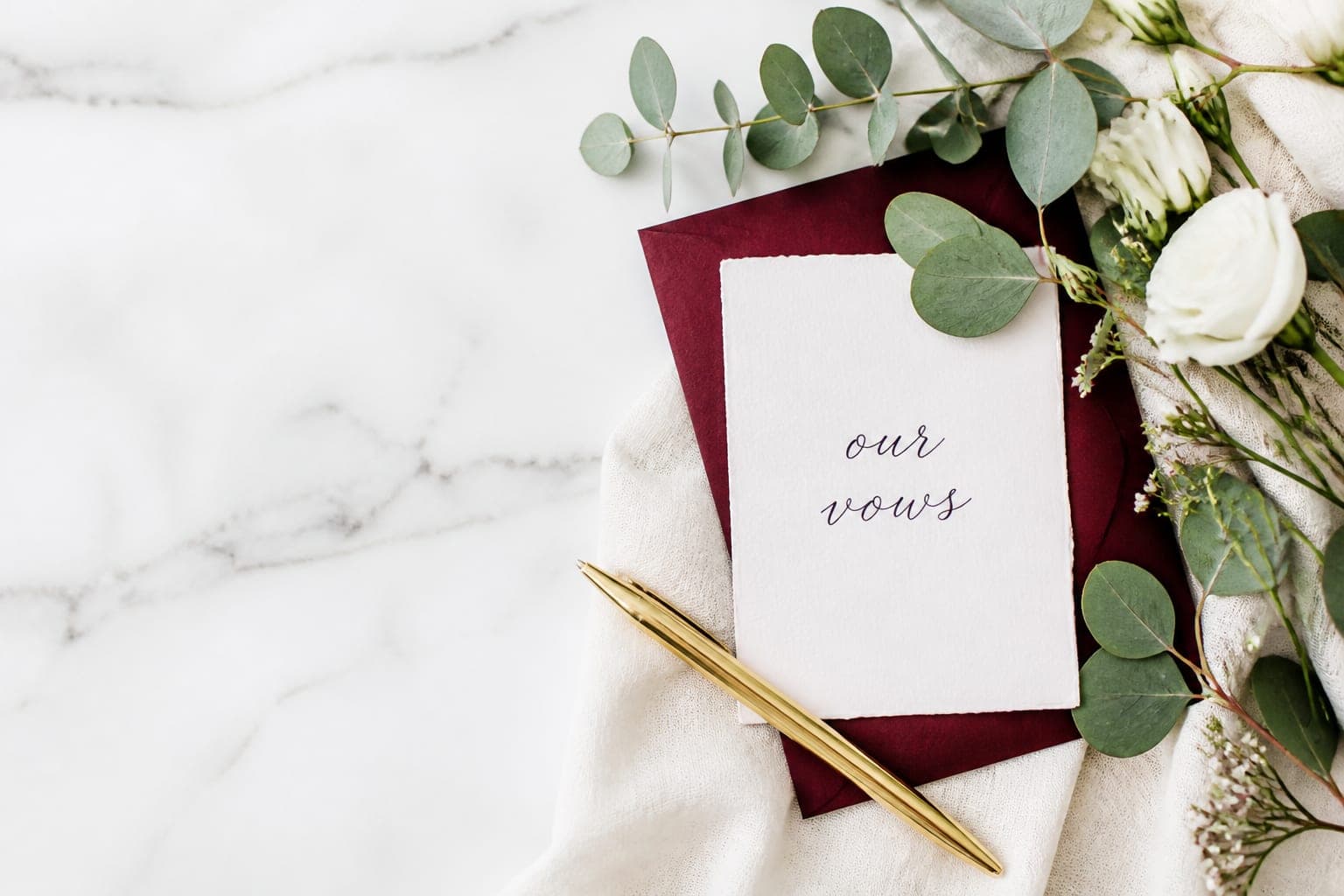
Modern wedding vows for a ceremony that sounds like now
Modern wedding vows without the old script: what to replace, what is worth keeping, and six full non-traditional wordings you can actually say aloud.
2,359 words of guidance 6 full wordings Copy and personalize
Editorial status: general writing guidance based on the visible methodology; no page-level professional, cultural, or religious review is claimed. Last revised July 21, 2026. Read the policy.
Move from reading to writing
Use only the details you choose, then edit, version, rehearse, and print privately.
Modern vows are not traditional vows with the religion removed. They are a different argument about what a marriage is: two equal people describing the life they intend to build, in the language they actually use.
That freedom is the difficulty. Traditional wording arrives pre-loaded with weight, and when you drop it you have to generate that weight yourself, sentence by sentence. The examples below show how it is done.
You will also find a line-by-line list of what modern couples replace and what they keep. Most of the old structure survives. It is mainly the assumptions that go.
The short answer
Modern wedding vows keep the promise and drop the hierarchy: no obey, no giving away, no one-sided commitments.
Both partners usually say the same or closely matched wording, which is the clearest signal that the marriage is a partnership.
Forever language is optional. Many modern vows commit to choosing each other daily rather than to fate.
Keep one piece of ritual. Call and response, repeat-after-me, or a shared closing line gives a secular ceremony its ceremonial feel.
150 to 250 words, one to two minutes each, is still the working range.
Name the actual life you are building: work, money, rest, family, health. Modern vows earn their weight through specificity.
What modern vows dropped, and why
The traditional English wording came out of a specific world with specific assumptions about who promised what to whom. The most visible artifact is the bride's promise to obey, which appears in the earliest printed English marriage services and which twentieth-century revisions in many denominations dropped or made optional.
Modern couples tend to drop three more things alongside it. The transfer of a bride from one household to another. The framing of marriage as a status conferred by an authority rather than an agreement made by two people. And the assumption that the promises differ by gender.
What is left is the part that was always doing the work: two people, in public, telling each other exactly what they intend to do.
Modern replacements for the traditional lines
You do not have to invent a whole new vocabulary. Most couples want the shape of the old lines with the assumptions taken out, and there are now standard swaps for each of them.
Read these out loud before choosing. Some of the modern versions are longer, and length changes rhythm more than meaning does.
To love, cherish, and to obey becomes to love you, to be honest with you, and to treat you as an equal in every decision.
Till death us do part becomes for as long as we both keep choosing this, or for all the days of my life.
Forsaking all others becomes I choose you, and I will keep choosing you, or you are my first call and my last word.
Man and wife becomes married, partners, or simply husband and husband, wife and wife, spouse and spouse.
In sickness and in health survives almost untouched, because it names something couples still mean literally.
According to God's holy ordinance becomes in front of the people who made us, or with everyone we love as witnesses.
Equal promises, said by both of you
The single most effective structural choice in a modern ceremony is symmetry. When both partners say the same wording, the equality is not asserted, it is demonstrated, and the room hears it immediately.
There are three easy ways to do this. Identical vows spoken in turn. Identical wording with one personal sentence each. Or a promise swap, where you alternate lines and each of you answers the other.
Symmetry also solves the mismatch problem. Nobody can write four minutes while the other writes forty seconds if the text is shared.
If you want personal vows and symmetry, agree on a shared opening phrase and a shared final line, and write the middles separately. The bookends do the pairing.
The ceremonial structures worth borrowing
Secular ceremonies sometimes feel thin, and the reason is almost always structural rather than emotional. Traditional services carry ritual devices that make a room go quiet, and none of those devices are religious.
Borrow at least one. It costs nothing and it is the difference between a ceremony and an announcement.
Call and response: the officiant asks, you answer. Do you promise to ... I do.
Repeat after me: the officiant feeds you each line. Slow, formal, and impossible to blank on.
The declaration of intent: the will you take questions asked before the vows, which most civil ceremonies already include.
A shared closing line said in unison by both partners.
The witness response: the officiant asks the guests to support the marriage, and everyone answers we will.
Naming a modern life out loud
Modern vows get their authority from specifics about the life you are actually agreeing to. Careers that move cities. Money that has to be discussed. Rest that has to be defended. Aging parents, chosen family, decisions about children that may or may not be settled.
Naming one of these is powerful. Naming five turns the vow into a household policy document. Pick the one your marriage will genuinely be tested on and promise something about it in plain language.
Keep the phrasing warm rather than administrative. I promise to protect your Sundays is a vow. I promise to maintain an equitable division of domestic labor is a memo.
Second marriages, blended families, and open history
Modern ceremonies are frequently second ceremonies, and modern vows are unusually good at handling that. There is no requirement to pretend this is the first time either of you has stood here.
One acknowledging line does the job. I know what a marriage costs, and I am here anyway. Then move forward, because the vow belongs to the present.
If children are present, include them by name with a short promise they can hold you to. Keep it to two sentences and make it something verifiable: I will be at the games, I will be awake at two in the morning, I am not going anywhere.
Keeping ritual without doctrine
Plenty of couples want the gravity of tradition without the theology. That is a solvable problem, and the solution is usually objects and repetition rather than language.
Rings, hands, candles, cords, stones passed through the guests, a shared cup, a tree planted afterward: all of these give a secular ceremony something physical to hold. Repetition does the rest. Anything said three times in a ceremony starts to feel like liturgy.
If a family tradition matters to a parent and not to you, look for the version you can say honestly. Borrowed language you do not believe is the one thing guests always hear.
If you are adapting a custom from a culture that is not yours, ask someone who holds it how it is properly done and whether it is appropriate to use. This site does not claim cultural or religious review.
What still works from the old wording
Some traditional phrases have survived every revision for a reason: they are short, concrete, and they name real conditions rather than feelings.
For better or for worse, for richer or for poorer, and in sickness and in health all describe circumstances a marriage will actually meet. Modern couples keep them, sometimes in plainer clothes, because there is no better version.
The other survivor is the rhythm. Traditional vows are built on pairs, and pairs are easy to say and easy to hear. Notice how many of the examples below use two-part phrases, and steal that if nothing else.
Delivering a modern ceremony well
Informality is a tone, not a plan. The ceremonies that feel relaxed are usually the ones with the tightest logistics behind them, because nobody has to guess what happens next.
Give your officiant a printed running order. Decide who speaks first and say it out loud at the rehearsal. Test the microphone in the actual space, outdoors especially, where wind eats the ends of sentences.
Then slow down. Modern vows have no liturgical rhythm to carry you, so pace is entirely on you. Pause at every paragraph break, and let the laugh finish before you speak again.
Full wordings you can use
Read the complete text, copy it, or take it into the private writer and make it yours.
Modern vows, plain and equal
The same wording spoken by both partners in turn. The clearest possible statement that this is a partnership.
First partner
I choose you. Not because a story told me to, and not because this is what people do, but because I have looked at the whole of you and I want it.
First partner
I promise to be honest with you, quickly and kindly. I promise to treat your work, your rest, and your worries as equal to mine. I promise to fight fair, repair fast, and never make you guess where you stand.
First partner
I am not promising that this will be easy. I am promising that I will be here, choosing you, for as long as we both keep choosing this.
Second partner
I choose you. Not because a story told me to, and not because this is what people do, but because I have looked at the whole of you and I want it.
Second partner
I promise to be honest with you, quickly and kindly. I promise to treat your work, your rest, and your worries as equal to mine. I promise to fight fair, repair fast, and never make you guess where you stand.
Second partner
I am not promising that this will be easy. I am promising that I will be here, choosing you, for as long as we both keep choosing this.
about 98 seconds spoken200 words
Identical text sounds deliberate rather than lazy, and it removes any risk of one vow overshadowing the other. Add one personal sentence each at the end if you want a little asymmetry.
The promise swap
Alternating lines, each partner answering the other. Reads as a conversation and keeps the room alert.
Maya
I promise to tell you the truth before it gets heavy.
Chris
And I promise to hear it without making you pay for it.
Maya
I promise to take my half of the ordinary work, without being asked and without keeping score.
Chris
And I promise to notice, out loud, when you have taken more than half.
Maya
I promise to protect your time to be someone other than my wife.
Chris
And I promise to come back to you at the end of it, every time.
Maya
I promise to stay when it is hard.
Chris
And I promise to make staying worth it.
Both
We are choosing this today, and we will keep choosing it.
about 54 seconds spoken109 words
Keep each line under fifteen words. The rhythm is the whole effect, and one long line kills it. Practise the handover once so neither of you rushes the other.
Modern repeat-after-me set
For couples who do not want to memorize anything. The officiant feeds each line in short phrases.
Officiant
Repeat after me. I, Sam, take you, Maya, as my partner in this.
Sam
I, Sam, take you, Maya, as my partner in this.
Officiant
I promise to be honest with you and gentle with you.
Sam
I promise to be honest with you and gentle with you.
Officiant
To share the work, the money, and the decisions.
Sam
To share the work, the money, and the decisions.
Officiant
To stay curious about who you are becoming.
Sam
To stay curious about who you are becoming.
Officiant
And to keep choosing you, on purpose, for the rest of my life.
Sam
And to keep choosing you, on purpose, for the rest of my life.
about 53 seconds spoken105 words
Every phrase here is under ten words, which is the limit for reliable repetition under pressure. Send this to your officiant in advance so the breaks land where you expect them.
Non-traditional vows with no forever language
For couples who would rather commit to daily choice than to fate. Nothing here promises what cannot be promised.
I am not going to tell you this was written in the stars, because you would look at me strangely and you would be right.
This was decided. By me, repeatedly, over four years, in full possession of the facts.
So here is the commitment I can actually make. I will decide for you again tomorrow. I will decide for you in a bad month. I will decide for you when we are dull, or broke, or tired, or unimpressed with each other.
I will do the maintenance. I will say the difficult thing early. I will not let a small resentment become a large one while I wait for the right moment.
This is not fate, Chris. It is better than fate. It is a choice I intend to keep making until I am out of days.
about 64 seconds spoken138 words
Rejecting the usual romantic vocabulary works only if you replace it with something stronger. The move here is to make choice sound more committed than destiny.
Modern vows for a couple with children
Includes the children by name without turning the vow into a family address.
Maya, we are not starting a family today. We already have one, and it is loud, and it is in the second row.
What we are doing is saying out loud what we have been doing quietly for three years.
I promise to be a steady adult in this house. I promise to disagree with you privately and support you publicly. I promise to keep our marriage its own thing, not just the administration of everybody else's schedule.
Ada and Theo, here is your part. I promise to be at the things that matter to you. I promise to be awake when you need me, whatever time it is. I am not going anywhere, and you can hold me to that.
All four of us, from here. That is the promise.
about 60 seconds spoken131 words
Two sentences to the children is the right dose. Longer, and the vow stops being between the two of you, which is what the ceremony is for.
The sixty-word modern vow
Secular, symmetrical, and short enough for a windy outdoor ceremony with a bad microphone.
You are my favorite person and my first call.
I promise to be honest, to be fair, and to be here.
I promise to build a life with you that we both actually want to live in.
No fate, no fine print. Just me, choosing you, out loud, in front of everyone we love.
about 25 seconds spoken54 words
Short modern vows need one memorable phrase to survive the wind. Here it is no fate, no fine print, which is the line people will repeat at the reception.
Examples to adapt
Filter, copy, and save examples that match your role and tone.
Provenance: these are synthetic teaching examples written for illustration, not customer submissions or a real couple’s transcript. Replace generic lines with facts you can confirm.
6 examples
FAQs
What are modern wedding vows?
Modern wedding vows are personal, non-hierarchical promises written in everyday language, usually spoken in matching form by both partners. They keep the commitment of traditional vows and drop the gendered and doctrinal assumptions built into the older wording.
What do modern couples say instead of till death do us part?
Common alternatives are for as long as we both keep choosing this, for all the days of my life, and for the rest of my life. Each keeps the finality without the fatalistic framing.
Do modern wedding vows still include obey?
Almost never. The promise to obey comes from the earliest printed English marriage services, and many denominations dropped it or made it optional during twentieth-century revisions. Modern secular vows replace it with promises of equality and honesty.
Can non-traditional vows still feel solemn?
Yes. Solemnity comes from specificity, pace, and ritual structure rather than from old language. A precise promise said slowly, inside a call-and-response or repeat-after-me frame, carries as much weight as any traditional wording.
Should both partners say the same modern vows?
Matching wording is the simplest way to demonstrate equality, and it removes any risk of one vow overshadowing the other. If you want personal content too, use shared opening and closing lines with different middles.
Are modern wedding vows allowed in a civil ceremony?
Usually yes, alongside the fixed legal declaration your registrar or officiant is required to include. Confirm with them which words are mandatory and where your own wording fits, since rules vary by jurisdiction.
How long should modern wedding vows be?
150 to 250 words each, or one to two minutes spoken. Shorter is fine outdoors, where wind and open air make long sentences hard to follow.
How do we make a secular ceremony feel like a ceremony?
Borrow one ritual device: call and response, repeat after me, a line spoken in unison, or a physical object like rings or a shared cup. Repetition and objects, not religious language, are what make a room go quiet.
Can modern vows mention money, work, or mental health?
One of them, yes, and it often makes the vow. Keep the phrasing warm rather than administrative, and do not name anything about your partner's health or finances without agreeing on it first.