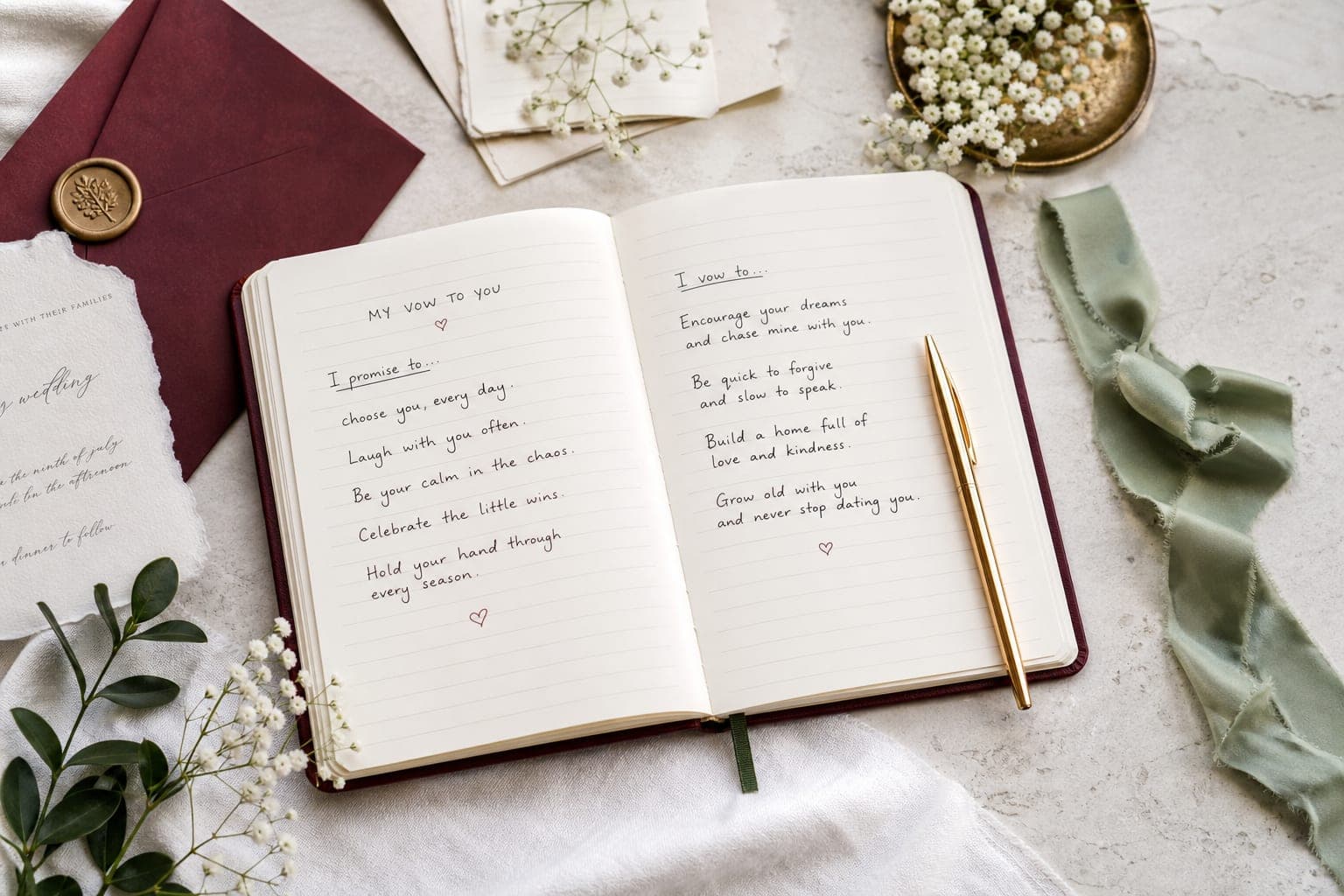
How to write personal wedding vows, with a material-gathering session, a structure that holds, six full examples, and the edits that make them speakable.
2,739 words of guidance 6 full wordings Copy and personalize
Editorial status: general writing guidance based on the visible methodology; no page-level professional, cultural, or religious review is claimed. Last revised July 21, 2026. Read the policy.
Move from reading to writing
Use only the details you choose, then edit, version, rehearse, and print privately.
Writing your own vows is not a writing problem. It is a noticing problem. The couples who struggle are almost never short of feeling, they are short of specifics, and specifics are collected rather than invented.
This page gives you the collection method first, then a structure that holds a real story, then six complete personal vows you can read for shape. Every example is written to be spoken by a normal person in front of people they know.
Give yourself four weeks and one honest conversation with your partner about length and tone. That combination solves most of what makes personal vows hard.
The short answer
Personal wedding vows run 150 to 250 words, or one to two minutes spoken.
Start by collecting material, not by writing sentences. Thirty minutes of listed details beats three evenings of staring at a blank page.
The structure that reliably works: open on something concrete, give two or three pieces of evidence, turn, make two or three promises, close in one short line.
Agree with your partner in advance on length, tone, humor, whether faith is mentioned, and whether you will read each other's drafts.
Read every draft aloud standing up. Anything you stumble over twice gets rewritten shorter, not smoothed.
If your ceremony wording is fixed, personal vows still fit: a private reading, a letter exchanged that morning, or a first-look moment.
What personal vows are actually promising to do
A personal vow has two jobs. It tells the room something true about this specific relationship, and it commits you to something specific you will do about it. Most weak vows do the first job and skip the second.
That is why gratitude alone falls flat. Thank you for loving me is a lovely sentence and it obligates you to nothing. The vow only becomes a vow at the moment you say what you will do.
Keep the ratio roughly even. Half of your words describe what is true. Half of them describe what you will do about it. If the promises are less than a third of the vow, you have written a toast.
The thirty-minute material session
Sit down with paper, set a timer, and answer as many of these as you can in short fragments. Do not write in vow language. Do not try to be moving. You are strip-mining your own memory, and the polishing comes later.
Most people produce twenty or thirty fragments in half an hour and use four of them. That ratio is normal and it is the reason the finished vow feels chosen rather than assembled.
Name three things they do weekly that you would notice immediately if they stopped.
Write down the exact sentence they said that you still think about.
Name the hardest thing you have gone through together and one thing they did during it.
Write down a thing you were wrong about, and how they corrected you without humiliating you.
Name the place you feel most like yourselves, and what you are usually doing there.
Finish this sentence five different ways: before you, I thought love was ...
Write down what you are afraid of about marriage, in one line. It usually becomes the strongest promise.
Do this separately, then compare fragments a week later if you plan to share drafts. Overlapping details are worth keeping in one vow and cutting from the other.
A structure that holds a personal story
The order matters more than the sentences. This five-part shape carries a real story without collapsing, and it works at any length from 90 words to 300.
Write the parts out of order if you like, but assemble them in this sequence. The turn is the hinge, and it is usually a single word: so, and so, that is why, which is why.
Open on something concrete: an image, a habit, a place, a fact. Never open on an abstraction about love.
Give two or three pieces of evidence. Specific, unarguable, small.
Turn. One line that converts what is true into what it means.
Promise two or three things you can actually do, phrased as actions rather than feelings.
Close in one short sentence you could say with your eyes shut. Nine words or fewer.
Decide these six things together before you write
Most vow disasters are coordination failures rather than writing failures. One partner writes four minutes of poetry and the other writes forty seconds of jokes, and both of them feel bad about it in front of two hundred people.
Have one twenty-minute conversation. Write the answers down. Then write separately.
Length: pick a range, such as one to two minutes each, not a word count.
Tone: mostly sincere, mostly funny, or one joke early and sincere after.
Faith: whether either of you names it, and how explicitly.
Children, exes, and family: what is named out loud and what is not.
Sharing: whether you read each other's drafts, share with one friend, or keep them sealed.
Deadline: the date the final version is printed. Two weeks before the wedding, not the night before.
How much to say in public
Vows are a public document. Everyone you both know is standing there, plus their parents, plus a camera. That is not a reason to be bland, but it is a reason to be deliberate about what belongs to the two of you and what belongs to the room.
The reliable filter: could your partner hear this line read aloud by a stranger without flinching? Health, money, mental health, past relationships, and family conflict all fail that test unless you have explicitly agreed to include them.
You can gesture at a hard season without narrating it. The year we do not talk about much tells the room everything it needs while keeping the details where they belong.
If a line is too private for the ceremony but too true to lose, put it in the letter you exchange that morning. Nearly every couple ends up with both documents.
Writing separately, coordinating anyway
Write alone. Vows composed jointly tend to average out into something neither of you would have said, and the surprise of hearing your partner's actual voice is a real part of the ceremony.
Coordinate on the frame instead: the length, the tone, whether you both open by naming each other, whether you both end with a version of the same line. Shared bookends with different middles is the most reliable way to sound designed as a pair.
One useful trick if you are nervous about mismatch: agree on the first three words. Both of you begin with the same phrase, and the vows immediately read as two halves of one thing.
A four-week drafting schedule
Personal vows fail most often through timing, not talent. Written the night before, they get memorized badly, printed badly, and delivered at whatever length panic produces.
Four weeks is enough for anyone. Two of those weeks are just letting the draft sit.
Week one: the thirty-minute material session, plus the coordination conversation with your partner.
Week two: write a bad long draft, deliberately over length. Do not edit while writing.
Week three: cut to your agreed range, read aloud standing up, and rewrite anything you stumble over twice.
Week four: final read aloud with a stopwatch, print on card stock in 16 point type, and give the card to whoever is holding it on the day.
The edit that makes vows speakable
Reading aloud is not a final check, it is the main editing tool. Text that looks elegant on screen frequently cannot be spoken: too many clauses, too many soft consonants in a row, sentences whose ends arrive after your breath does.
Do three passes. First for breath: any sentence you cannot finish comfortably gets split. Second for stumbles: mark the words you trip on and swap them for plainer ones. Third for the ending: the last line should be short enough to say while looking up.
Then hand the vow to one honest friend and ask a single question: is there any line here that made you wince? Cut whatever they name. They are right.
If your ceremony wording is fixed
Some ceremonies set the vows. Many religious traditions and some civil registries require specific wording, and a few venues limit what can be added. That does not remove personal vows from your wedding, it relocates them.
The common placements: a private exchange during a first look, a letter each of you writes and reads that morning, a short personal addition after the required wording if your officiant allows it, or a few personal lines inside your reception toast.
Ask your officiant early, at the first planning meeting rather than the week before. The answer determines your entire drafting timeline and it is not a question you want answered while programs are at the printer.
Full wordings you can use
Read the complete text, copy it, or take it into the private writer and make it yours.
Personal vows for a long relationship
For couples who have already built the life. Treats the wedding as a signature on something real rather than a beginning from zero.
Chris, we have been doing this for nine years, so I am not going to stand here and promise you a future I have not already been living in.
I know what you are like at four in the morning when the flight is delayed. I know what you are like in a hospital corridor. I know exactly how you sound when you are pretending the news is fine.
Nine years ago I would have said I loved you. I did. But I was mostly guessing. Now I have the data.
So today I am promising you the things I know I can do, because I have already done them. I promise to keep showing up in the corridor. I promise to keep telling you when the news is not fine. I promise to protect the parts of your life that have nothing to do with me, because that is where half of who you are lives.
And I promise to keep choosing this on the days it is unremarkable, which is most days, and which is the whole point.
Nine years in, I am still the luckiest person in this room.
about 89 seconds spoken192 words
Long-relationship vows should use their history as evidence rather than as nostalgia. Notice that no sentence here recaps how they met.
Personal vows for someone who is not a words person
Short, blunt, and honest about being uncomfortable. Often the most affecting vow at the wedding.
Everyone here knows I do not talk like this, so I am going to be quick and I am going to mean all of it.
Maya, you are the best thing that has happened to me. I have known that since the second week.
I am not going to promise to be romantic, because you would laugh, and because I would fail. Here is what I will do instead.
I will be there. Every time. I will fix what I can fix and sit with you through what I cannot. I will tell you the truth even when I have to work up to it.
You do not have to wonder about me. That is my vow.
about 54 seconds spoken117 words
Naming your own discomfort in the first line is not a weakness, it is a credibility move. Then keep the promises concrete and stop before you drift.
Personal vows with one joke early
Humor in the first third, sincerity in the last two. The safest way to be funny in a ceremony.
Sam, I have written four versions of this. The first one had a bit in it about your driving. My sister read it and said, absolutely not, so you are all welcome.
Here is what survived.
You are the most patient person I have ever met, and I say that as the person who tests it most. You waited two years for me to be ready. You waited eight months while I fell apart and put myself back together in the wrong order. You have never once used any of it against me.
So I promise to be worth the patience. I promise to be honest with you before it is comfortable. I promise to take care of the boring half of our life without keeping a ledger about it.
And I promise to keep letting you drive.
I love you. I am ready. Let us go.
about 68 seconds spoken147 words
The joke returns at the end as a callback, which is why the funny opening does not undercut the sincerity in the middle.
Personal vows for a blended family
Speaks to a partner and to children by name. Keep the promise to the kids short, specific, and possible.
Maya, I am marrying you with my eyes open and my hands full, which is exactly how I want to do it.
You did not just make room for me. You made room for a nine-year-old who tests every adult he meets, and you passed every test he set without ever making him feel like it was one.
So I promise you the ordinary things. I promise to be honest early. I promise to keep our disagreements ours. I promise to keep learning how to be married, because I would like to be better at it this time.
And Theo, I want to say this in front of everybody, so you can hold me to it. I am not replacing anyone. I am not going anywhere. If you need me at two in the morning, I will be awake. That is a promise, and you get to remind me of it.
The three of us are the plan. I am in for all of it.
about 76 seconds spoken165 words
Promises to children should be things a child can verify: I will be at the games, I will be awake, I am not going anywhere. Avoid promising feelings on their behalf.
Personal vows for a private person
Warm and specific without revealing anything your partner would not want said out loud.
There is a version of this vow with our whole story in it. You would hate it, so I wrote this one instead.
Here is what I am willing to tell everyone. You are steadier than anyone I know. You are kind in ways that nobody sees, including, sometimes, the people you are being kind to. You have never made me feel like an inconvenience, not once, not even at my worst.
The rest is ours, and it is staying ours.
Chris, I promise to guard the quiet you need. I promise to say the difficult thing rather than let it sit. I promise to keep the parts of our life that belong to us out of everybody else's hands.
I will love you carefully and out loud, in the proportions you actually want.
about 62 seconds spoken134 words
Protecting a private partner in the vow itself is a form of devotion, and guests hear it that way. The restraint reads as intimacy rather than distance.
Personal vows built from one ordinary day
A single Tuesday used as the whole argument. Good if your relationship has no dramatic story and you keep feeling like it needs one.
I want to tell you about a Tuesday, because that is where I actually live with you.
You get up first. You open the blinds halfway, not all the way, because you know the light hurts my eyes before coffee. You put the radio on low. Around eight you shout something at the news, and around eight fifteen you apologize to me for shouting at the news.
We work. We text about nothing. You send me a photograph of a dog you saw. I send you the crossword clue I cannot get and you solve it in four minutes, which is infuriating.
In the evening we cook badly and eat late and you tell me about somebody at work whose name I can never remember, and I listen to the way you talk about them, which is always more generous than they deserve.
That is it. That is the day. There is no dramatic story in this vow because our life is not dramatic, and I would not trade a single Tuesday of it.
So, Sam, I promise to keep the Tuesdays good. I promise to be generous about people the way you are. I promise to notice the blinds, and the radio, and the thousand small adjustments you make so my day starts gently.
I am marrying you for the ordinary days. There are going to be so many of them, and I want all of them with you.
about 111 seconds spoken240 words
The most portable structure on this page. Take one real day, narrate it in the present tense, and let the promises come out of the details you just named.
Examples to adapt
Filter, copy, and save examples that match your role and tone.
Provenance: these are synthetic teaching examples written for illustration, not customer submissions or a real couple’s transcript. Replace generic lines with facts you can confirm.
6 examples
FAQs
How do I write personal wedding vows?
Collect details before you write sentences: habits, exact words they said, and what they did during your hardest season. Then use a fixed shape, open on something concrete, give evidence, turn, promise two or three things, and close in one short line.
How long should personal vows be?
150 to 250 words, which is about one to two minutes spoken. That is enough for one story and two or three promises without turning the ceremony into a speech.
Should we write our own vows or use traditional wording?
Many couples do both: the traditional wording carries the ceremony's formal weight and a short personal addition carries the specifics. If your tradition sets the vows, ask your officiant whether an addition is permitted before you draft anything.
Should we read each other's vows before the wedding?
It is optional, but coordinating length and tone is not. A common compromise is to keep the text secret and share the word count, or to have one trusted friend read both and confirm they are balanced.
When should we start writing our vows?
About four weeks out. Week one for gathering material, week two for a deliberately long draft, week three for cutting and reading aloud, week four for the final timed read and printing.
What should you not say in personal vows?
Avoid anything about your partner's health, finances, family conflict, or past relationships that they have not agreed to make public. Also cut inside jokes that need explaining and any promise you know you cannot keep.
Is it okay to cry during your vows?
Yes, and it is common. Build a pause into the draft where you expect to break, keep the closing line short, and let your officiant hold your card so you can take a breath without losing your place.
Can I use an example vow as a starting point?
Yes. Borrow the structure rather than the sentences: note where the example opens, where it turns, and how long its promises are, then fill that shape with your own details.
Should personal vows mention marriage itself?
One line is usually enough. A promise about protecting the marriage, not just about being a good partner inside it, gives the vow a grown-up weight that pure romance does not.